Bioinformatics and computational biology.
Exploring the Digital Foundations of Modern Biological Research
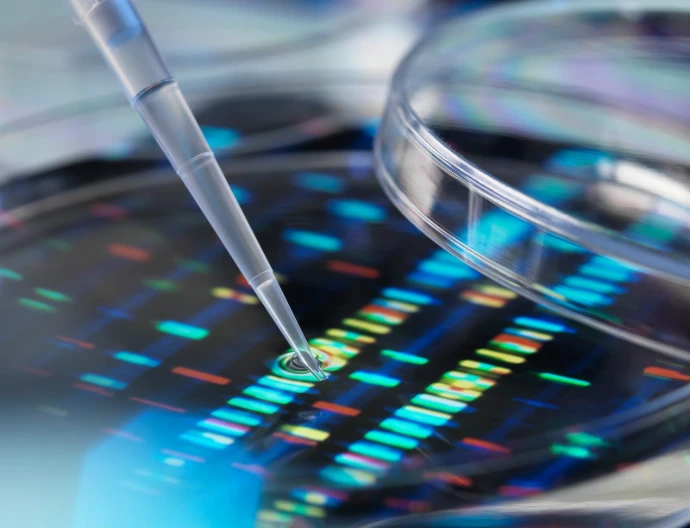
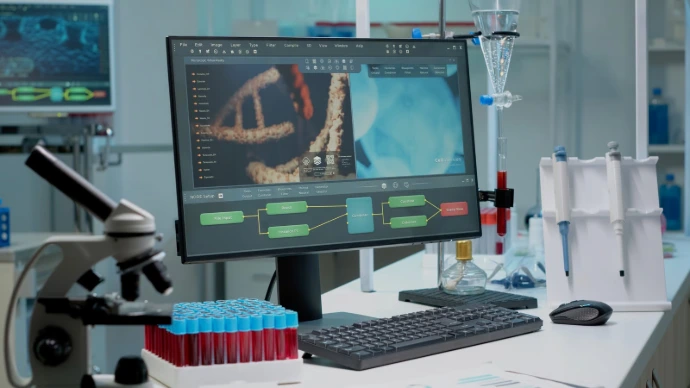
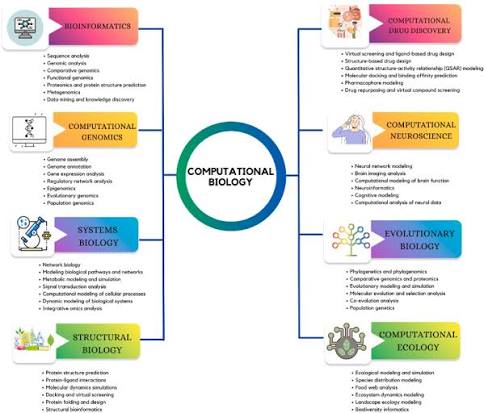
The rapid development of molecular biology, genomics, biotechnology, and biomedical research has generated increasingly complex biological datasets. Understanding this information requires advanced analytical approaches capable of connecting molecular observations with broader biological processes. Bioinformatics and computational biology have consequently become essential disciplines for interpreting biological data, investigating molecular mechanisms, and supporting scientific discovery.
By combining biology, computer science, mathematics, statistics, and data science, these interdisciplinary fields provide researchers with tools to analyze genetic sequences, characterize proteins, investigate metabolic pathways, and explore relationships between biological systems.
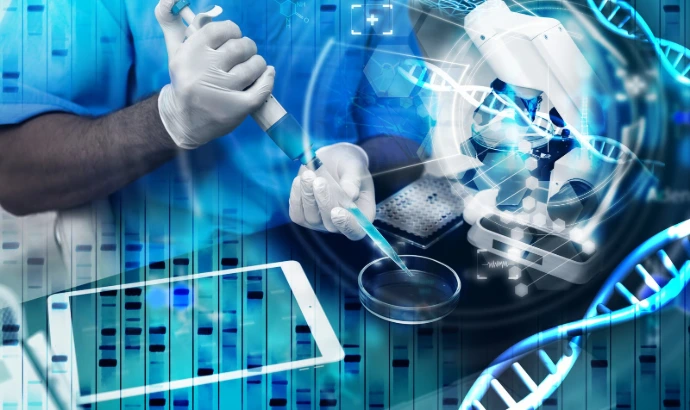
Bioinformatics primarily focuses on the organization, processing, management, and interpretation of biological information through computational tools and databases. Computational biology uses mathematical models, statistical methods, simulations, and algorithms to investigate biological mechanisms and predict the behavior of complex systems.
Together, these disciplines contribute to the development of modern research strategies across molecular biology, medicine, pharmaceutical sciences, genetics, microbiology, and biotechnology.

Understanding the Foundations of Bioinformatics
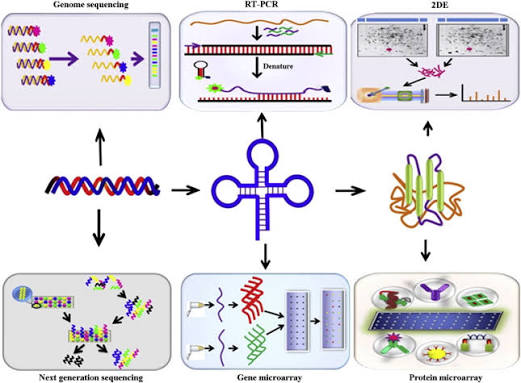
Bioinformatics involves the application of computational techniques to biological information. It supports the analysis of large datasets generated through experimental technologies, including DNA sequencing, RNA sequencing, protein characterization, and high-throughput molecular assays.
One of its fundamental objectives is to transform raw experimental information into biologically meaningful knowledge.
Researchers use bioinformatics approaches to identify genetic sequences, compare molecular structures, detect genetic variations, investigate gene expression, and characterize relationships between biological molecules.
Major areas of bioinformatics include:
DNA and RNA sequence analysis.
Genome assembly and annotation.
Comparative genomics and evolutionary analysis.
Transcriptomic data interpretation.
Protein sequence and structure analysis.
Biological database management.
Molecular pathway investigation.
Functional annotation and gene classification.
Microbiome and metagenomic analysis.
These approaches help researchers investigate biological questions that would be difficult to address through experimental observations alone.
Computational Biology and Mathematical Modeling
Computational biology focuses on using mathematical and computational frameworks to understand biological systems.
Unlike approaches limited to the analysis of existing datasets, computational biology can also involve developing predictive models and simulations that reproduce biological processes under different conditions.
Mathematical models can represent interactions between genes, proteins, metabolites, cells, and environmental factors. These models allow researchers to examine how changes in individual components may influence the behavior of an entire biological system.
Important computational approaches include:
Statistical modeling of biological processes.
Simulation of molecular interactions.
Mathematical representation of metabolic pathways.
Modeling of gene regulatory networks.
Population genetics and evolutionary modeling.
Computational analysis of cellular signaling.
Predictive modeling of biological responses.
These techniques are particularly valuable when investigating complex biological phenomena involving numerous interacting variables.
Genomic Data Analysis and Sequence Interpretation
Genomics is one of the most established application areas of bioinformatics. The analysis of genomic information allows researchers to investigate genetic organization, sequence variation, gene structure, and evolutionary relationships.
Modern sequencing technologies generate large quantities of DNA information that require specialized computational pipelines for quality control, assembly, alignment, and annotation.
A typical genomic analysis workflow may include:
Sequence quality assessment: Evaluating sequencing quality, identifying low-quality reads, and detecting technical biases.
Read preprocessing: Removing adapters, filtering unreliable sequences, and preparing data for downstream analysis.
Sequence alignment: Mapping reads against reference genomes using appropriate alignment algorithms.
Variant identification: Detecting single-nucleotide variants, insertions, deletions, and other genomic alterations.
Functional annotation: Investigating the potential biological significance of identified genetic features.
Data interpretation: Connecting genomic observations with biological functions and relevant research questions.
Commonly used tools include FastQC, fastp, BWA, Bowtie2, SAMtools, and GATK.
The appropriate selection of computational tools depends on the sequencing technology, research objective, reference resources, and characteristics of the biological samples.

Transcriptomics and Gene Expression Analysis
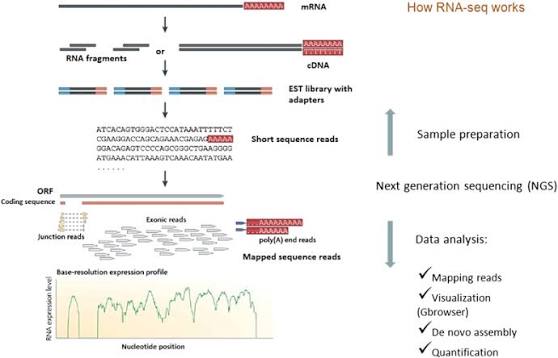
Transcriptomics investigates the complete set of RNA transcripts expressed within a biological sample under specific experimental conditions.
RNA sequencing (RNA-seq) is widely used to examine gene expression patterns, identify differentially expressed genes, and investigate molecular responses to experimental treatments or biological conditions.
A typical RNA-seq workflow includes:
Assessment of sequencing quality.
Read trimming and preprocessing.
Alignment or transcript quantification.
Gene expression normalization.
Differential expression analysis.
Functional enrichment analysis.
Biological interpretation and visualization.
Tools such as STAR, HISAT2, Salmon, DESeq2, and edgeR are frequently used in transcriptomic investigations.
Differential expression analysis can help identify genes whose expression levels change between experimental groups. These results may provide insights into biological pathways associated with cellular adaptation, inflammation, metabolism, disease development, and pharmacological responses.
Protein Bioinformatics and Structural Analysis
Proteins perform essential biological functions, including enzymatic catalysis, molecular transport, cellular communication, immune recognition, and structural organization.
Protein bioinformatics involves the computational analysis of amino acid sequences, protein domains, functional motifs, three-dimensional structures, and molecular interactions.
Sequence-based analysis can help identify similarities between proteins, predict functional regions, and investigate evolutionary conservation.
Structural bioinformatics extends these approaches by examining the spatial organization of proteins and their interactions with other molecules.
Important applications include:
Protein sequence alignment.
Identification of conserved domains.
Prediction of protein secondary structures.
Three-dimensional structure analysis.
Protein–protein interaction investigation.
Molecular docking and ligand interaction studies.
Functional prediction and annotation.
Resources such as UniProt, the Protein Data Bank (PDB), InterPro, and Pfam provide valuable information for protein characterization.
Computational structural approaches can also contribute to pharmaceutical research by supporting the investigation of potential molecular targets and compound interactions.


Artificial Intelligence and Machine Learning in Biological Research
Artificial intelligence and machine learning are increasingly integrated into bioinformatics and computational biology.
These methods allow researchers to identify patterns in complex datasets, classify biological information, predict molecular properties, and investigate relationships that may not be immediately apparent through conventional analysis.
Machine learning algorithms can be applied to genomic classification, protein function prediction, disease-associated molecular signatures, and biological image analysis.
Deep learning approaches have also expanded the possibilities for analyzing protein structures, molecular sequences, and complex biological interactions.
Examples of applications include:
Prediction of protein structure and function.
Identification of genomic patterns.
Classification of biological samples.
Analysis of gene expression profiles.
Detection of molecular signatures.
Automated interpretation of biomedical images.
However, reliable computational predictions require appropriate training datasets, independent validation, transparent methodologies, and careful consideration of algorithmic limitations.
Artificial intelligence should therefore complement experimental investigation rather than replace biological validation.
Systems Biology and the Integration of Biological Networks
Systems biology investigates biological organisms as interconnected systems rather than isolated molecular components.
It combines experimental observations, computational modeling, and mathematical analysis to examine relationships between genes, proteins, metabolites, and cellular pathways.
Biological networks can represent interactions between different molecular components and help researchers understand how changes in one part of a system influence other processes.
Examples include:
Gene regulatory networks.
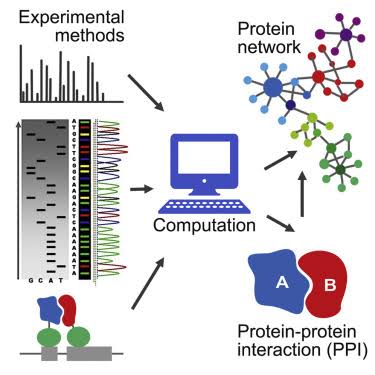
Protein–protein interaction networks.
Metabolic networks.
Cellular signaling pathways.
Host–microorganism interaction networks.
Molecular networks associated with disease mechanisms.
Network analysis can help identify highly connected molecular components, investigate pathway relationships, and explore potential regulatory mechanisms.
The integration of genomics, transcriptomics, proteomics, and metabolomics provides additional opportunities to investigate biological systems at multiple molecular levels.
Future Perspectives in Bioinformatics and Computational Biology
The future of bioinformatics will be shaped by advances in sequencing technologies, artificial intelligence, cloud computing, high-performance computing, and integrated molecular analysis.
Single-cell sequencing is expanding opportunities to investigate gene expression at the individual cell level, revealing biological differences that may be hidden within bulk tissue measurements.
Spatial transcriptomics provides additional information by connecting molecular expression profiles with their location within tissues.
Long-read sequencing technologies are improving the characterization of complex genomic regions, structural variations, and transcript isoforms.
At the same time, multi-omics integration is creating new opportunities to examine relationships between genetic information, gene expression, protein abundance, and metabolic activity.
Emerging research directions include:
Single-cell and spatial omics analysis.
Artificial intelligence-assisted molecular discovery.
Large-scale genomic data interpretation.
Advanced protein structure prediction.
Computational modeling of cellular systems.
Integrated multi-omics investigations.
Cloud-based collaborative research environments.
Personalized and predictive biomedical approaches.
These developments are expected to further strengthen the role of computational methods in modern biological research.
Conclusion
Bioinformatics and computational biology have become essential components of contemporary life sciences. By integrating biological knowledge with computational algorithms, statistical analysis, mathematical modeling, and data science, these disciplines provide powerful approaches for understanding complex biological information.
Their applications extend across genomics, transcriptomics, proteomics, structural biology, systems biology, microbiology, pharmaceutical research, and molecular medicine.
As experimental technologies continue to generate increasingly complex datasets, computational approaches will remain important for extracting meaningful biological information, developing predictive models, and supporting reproducible scientific investigations.
The continued integration of computational innovation and experimental biology offers valuable opportunities to advance molecular understanding and address emerging challenges in biomedical research.